
What Does a Limit Switch Mean? Definition, Key Functions & Real-World Case Study
When walking through a modern automated facility, observing a CNC machining center, or inspecting a high-speed conveyor sorting system, you are surrounded by vital electromechanical safeguards: limit switches.
So, what does a limit switch mean in industrial automation?
At its core, a limit switch is an electromechanical device operated by the physical force or movement of a machine part, sliding door, or workpiece. Its primary purpose is to “limit” or govern the range of motion of a mechanical assembly, sending an immediate electrical signal to stop, reverse, or redirect movement when a targeted boundary is reached.
Below is a detailed guide exploring what limit switches mean in practical engineering terms, a real-world client deployment case study illustrating the cost of overtravel failures, and comprehensive selection matrices for system integration.
1. Real-World Client Case Study: Preventing Catastrophic Over-Travel
A prominent automotive parts manufacturer in North America was operating a heavy-duty stamping and welding transfer line. The system relied on high-speed mechanical transfer arms to slide steel brackets into position for robotic welding.
The Engineering Challenge
During a high-speed production run, a positioning control glitch caused one of the primary transfer arms to push past its maximum safe operating boundary (overtravel). Because the previously installed limit switch lacked structural rigidity and failed to actuate reliably under heavy impact, the transfer arm crashed directly into the structural safety frame.
The resulting collision bent the steel arm, shattered the switch housing, and halted production for over 18 hours, costing the facility tens of thousands of dollars in unscheduled downtime, emergency repairs, and lost output.
The Kacon Solution
Following the incident, the plant maintenance engineering team partnered with Kacon to overhaul their safety interlocks and end-of-travel detection points. They retrofitted vulnerable impact zones with heavy-duty industrial solutions, specifically the Kacon KXL aluminum die-casting limit switch series, which features an IP67 enclosure rating and a mechanical lifespan rated for 10,000,000 operational cycles.
The Result
Equipped with rugged aluminum housings and reliable snap-action contacts compliant with IEC 60947-5-1 Low-Voltage Switchgear Standards, the upgraded limit switches absorbed high-impact mechanical feedback while instantly cutting circuit power the exact millisecond the arm reached its physical limit. The plant eliminated overtravel collisions entirely, securing continuous, uninterrupted manufacturing cycles.
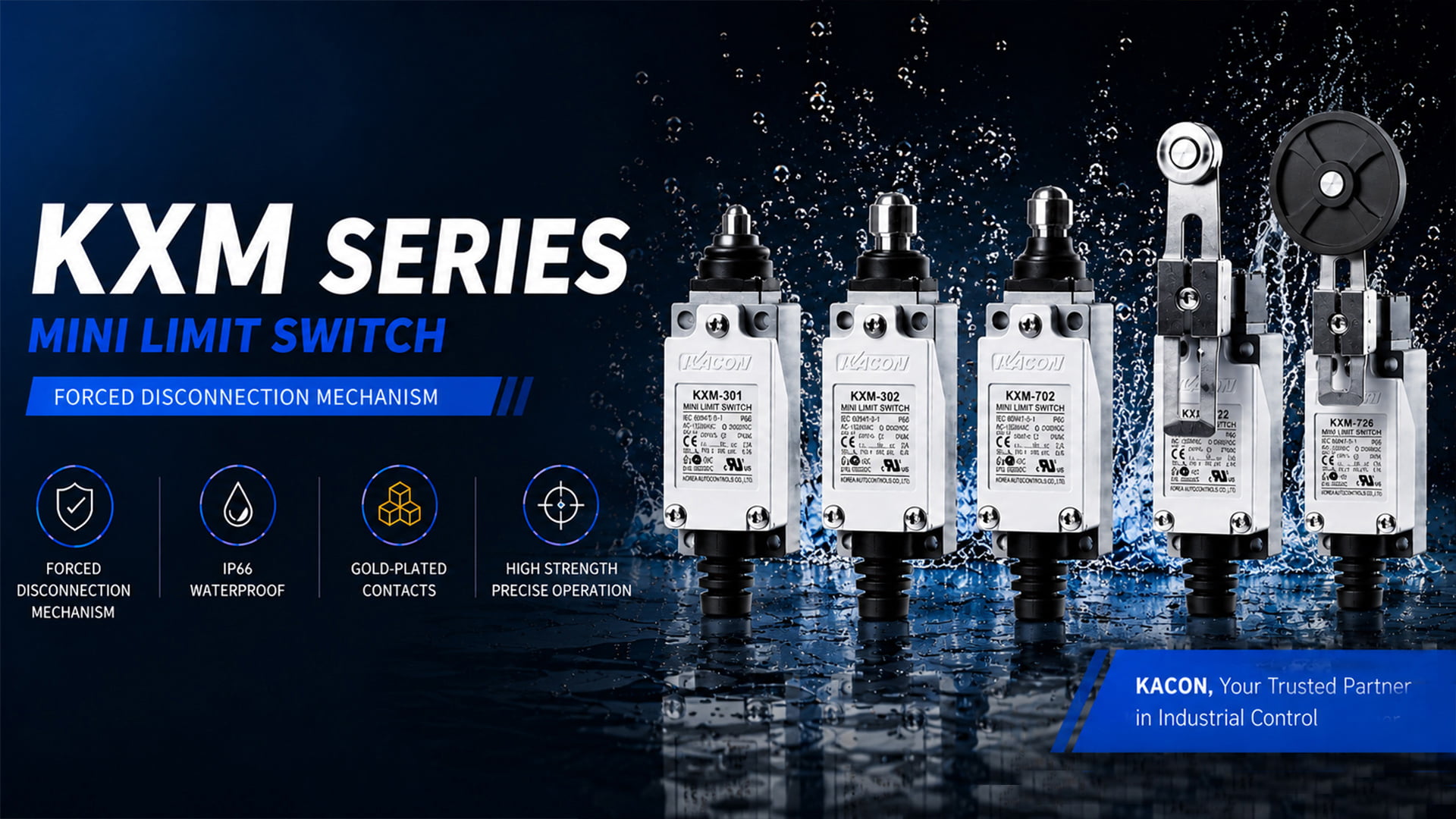
2. What Does a Limit Switch Mean in Automation? Key Functions
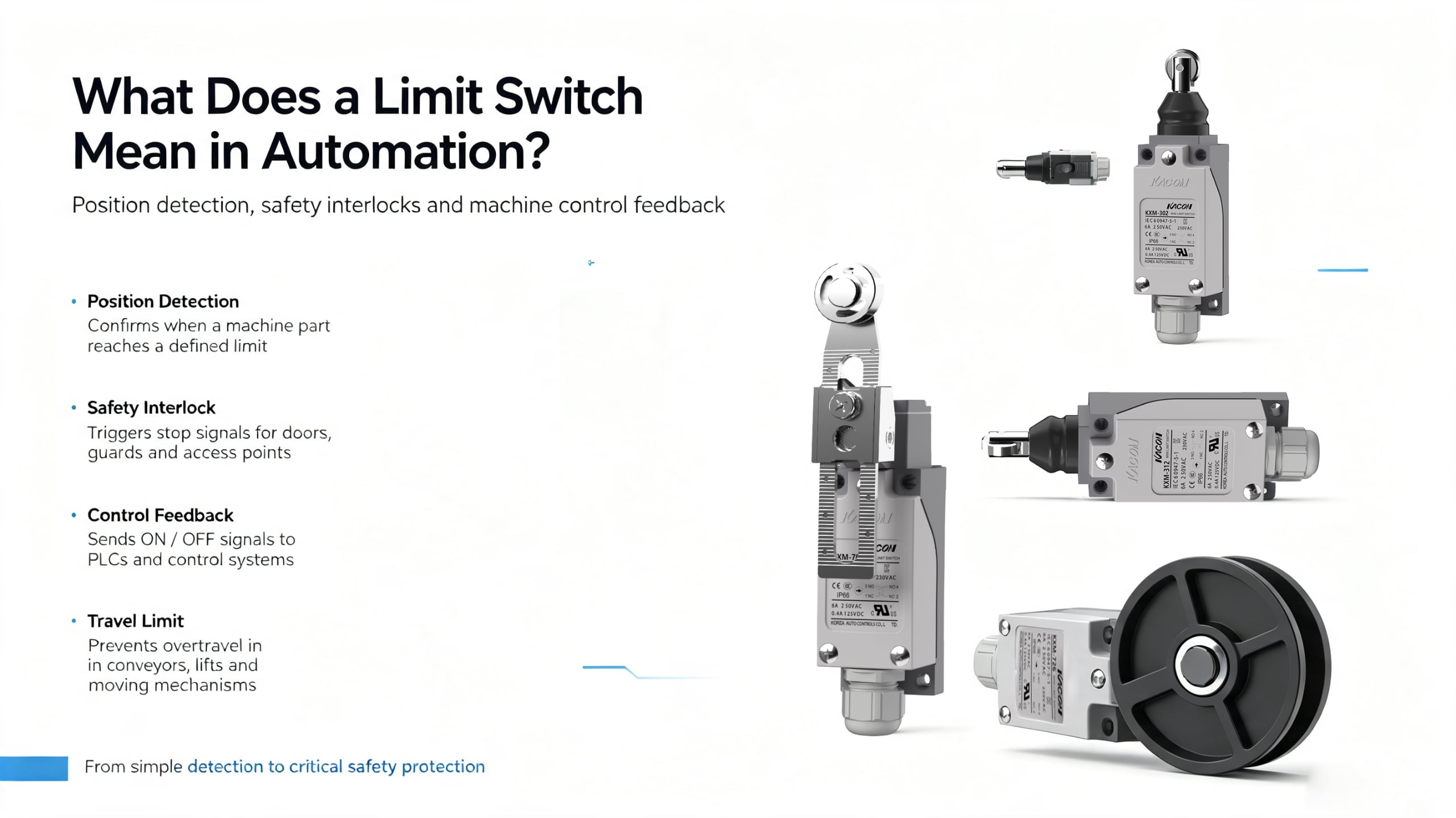
A limit switch bridges the physical movement of heavy machinery and the digital control architecture of Programmable Logic Controllers (PLCs). Its primary functions in a control loop include:
- Position & Guard Detection: Verifying whether a sliding safety door, enclosure hatch, or pneumatic clamp is fully open or tightly sealed before authorizing high-voltage drives to operate, satisfying safety requirements defined in ISO 13849-1 Machine Safety Guidelines and OSHA Machine Guarding Regulations.
- Overtravel Protection: Acting as a hard electromechanical safeguard to prevent moving assemblies (such as overhead crane hoists, elevator cars, or CNC axes) from exceeding physical safety limits and causing equipment collisions.
- Sequence Initiation: Sending a discrete signal to a PLC input card when a workpiece arrives at a workstation, initiating the next step in an automated assembly process.
For technical guidelines regarding electromechanical reliability and control system architecture, engineers frequently consult the IEEE Xplore Digital Library.
3. Limit Switch vs. Micro Switch: What Is the Difference?
While industrial limit switches and bare micro switches share internal snap-action principles, their housing structures, ingress protection, and application scopes differ significantly:
| Feature | Bare Micro Switch (Snap-Action) | Industrial Limit Switch (e.g., Kacon KXM / ZXG / KXL) |
|---|---|---|
| Primary Environment | Compact internal spaces, appliances, consumer electronics, and precision PCB jigs. | Rugged factory floors, outdoor conveyors, CNC machining centers, and heavy press frames. |
| Housing Material | Lightweight engineering plastic (PA66 / Phenolic resin). | Reinforced plastic (IP65/IP66) or heavy-duty Aluminum Die-Casting (NEMA 250 / IP67). |
| Actuator Design | Delicate pin plungers, light wire levers, or small leaf springs. | Heavy-duty roller arms, adjustable rotary levers, flexible spring rods, or reinforced plungers. |
| Electrical Capacity | Designed for micro-loads or light AC currents; exposed solder or spade terminals. | Built for industrial power or micro-load control circuits; internal conduit cable entries; dual-circuit blocks (1NO+1NC). |
4. Understanding Internal Reliability: Why Contact Material Matters
Whether deploying a compact position switch inside an enclosure or a heavy-duty limit switch on a press frame, internal electrical contact integrity is critical to avoiding unexpected downtime.
Modern automated control panels rely on PLCs operating on low-voltage micro-loads (24V DC at currents under 10 mA). In generic switches, standard silver contacts often fail because 24V DC micro-currents cannot generate the electrical arc required to burn away microscopic surface oxidation. Over time, contact resistance rises ($\ge 100\,\Omega$), leading the PLC to register a false “Open Circuit” fault even when the switch is mechanically closed. For standardized diagnostic procedures on continuity, review Fluke’s Technical Guide to Continuity Testing.
To eliminate false errors and secure lifelong signal clarity, high-performance switches from Kacon—such as the ZXG and KXM series—utilize oxidation-proof 24K gold-plated contacts (Ag alloy / 24K Au Plate). Because gold is chemically inert, it prevents oxide formation and maintains ultra-low contact resistance ($\le 25\text{ m}\Omega$), guaranteeing pristine signal transmission across millions of operating cycles.
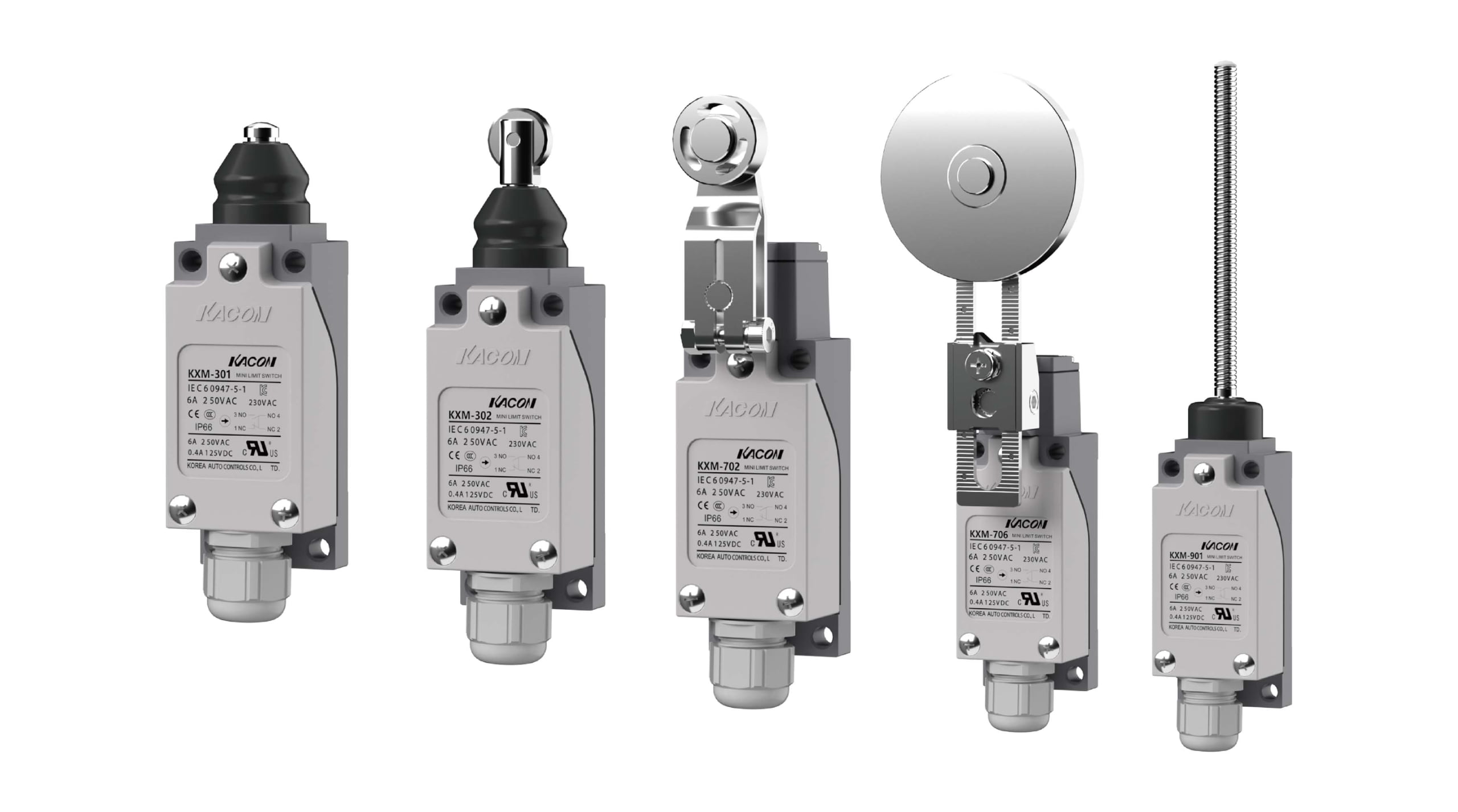
Summary Comparison Matrix of Kacon Industrial Limit Switches
| Model Series | Housing Material | Protection Degree | Contact Form & Material | Rated Current (250VAC) | Mechanical Life |
|---|---|---|---|---|---|
| ZXG Series | Reinforced Plastic | IP65 | 1NO + 1NC (Ag alloy / 24K Au Plate) | 10A | 10,000,000 cycles |
| KXM Series | Reinforced Plastic | IP66 | 1NO + 1NC (Ag alloy / 24K Au Plate) | 6A | 10,000,000 cycles |
| KXL Series | Aluminum Die-Casting | IP67 | 1NO + 1NC (Ag alloy) | 12A | 10,000,000 cycles |
Conclusion: Setting the Boundary for Machine Reliability
What does a limit switch mean? In modern manufacturing, it means the difference between smooth, automated precision and costly, catastrophic machine crashes.
By combining rugged external enclosures with gold-plated internal contact engineering—such as that found across Kacon’s industrial limit switch portfolio—operations can safeguard physical boundaries, protect capital equipment, and maintain uninterrupted production shift after shift.
External Technical References & Standards
For further study on limit switch specifications, enclosure ratings, and machinery safety standards, consult these authoritative industry resources:
- IEC 60947-5-1 Specifications for Low-Voltage Switchgear and Controlgear
- ISO 13849-1 Safety of Machinery – Safety-Related Parts of Control Systems
- OSHA General Industry Regulations for Machine Guarding
- NEMA 250 Specification Standard for Electrical Equipment Enclosures
- IEEE Xplore Digital Library – Control and Electromechanical Research
- Fluke Technical Guide: Testing Electrical Continuity with Digital Multimeters