
The $20,000 Click: Imagine a high-speed automotive assembly line. A robotic arm moves flawlessly, welding chassis components cycle after cycle. Suddenly, the entire line grinds to a halt. The culprit? Not a complex software glitch, and not an expensive motor burnout. A tiny, critical industrial limit switch regulating the carrier positioning has jammed due to minor off-axis shear stress from a passing cam. For every minute the line sits idle, the plant loses thousands of dollars.
In the modern landscape of smart manufacturing, we regularly praise optical sensors, machine vision systems, and wireless IO-Link devices. Yet, when an automated production line requires absolute safety, immutable position feedback, and heavy-duty reliability under punishing environments, it always relies on a classic powerhouse: the electromechanical industrial limit switch.
For automation and maintenance engineers, a limit switch is much more than a simple “on/off” trigger. Underestimating its internal complexity is a fast track to unpredictable signal chatter, melted electrical contacts, and catastrophic mechanical downtime.
As a leading innovator in heavy-duty control components, Kacon takes you beneath the rugged zinc-alloy casing of industrial limit switches. In this technical deep dive, we break down the internal structural anatomy, micro-mechanics, and critical safety principles that keep your machinery running safely and efficiently.
1. The Three Sub-Systems of Industrial Limit Switch Structural Anatomy
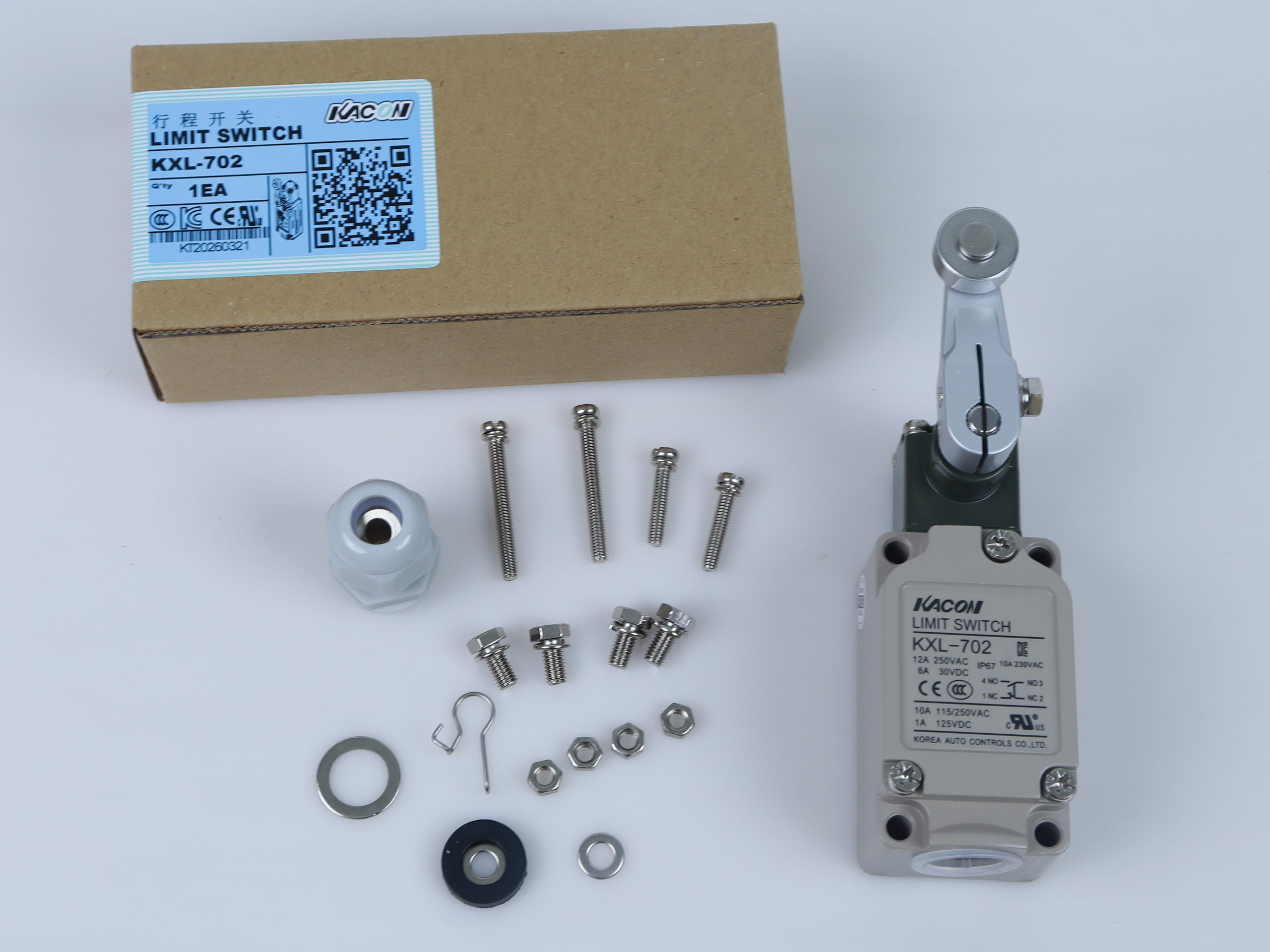
An industrial-grade electromechanical switch, such as the premium Kacon KXL Series, is divided into three distinct sub-systems, each engineered to survive millions of high-frequency cycles.
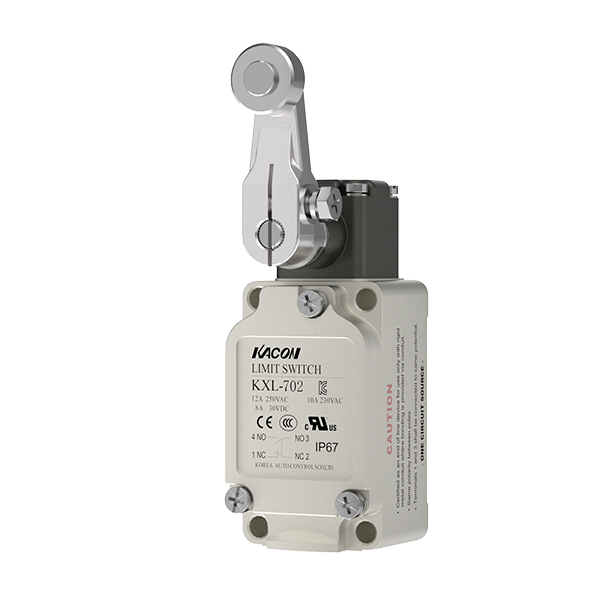
① The Actuator Head (The Mechanical Interface)
The operating head is the mechanical front-line. It encounters physical kinetic energy—whether linear, angled, or rotational—and converts it into an internal axial downward displacement. Whether utilizing a standard plunger, adjustable roller lever, or multi-directional flexible rod, the precise design of the head determines how force is transmitted to the core microswitch block.
② The Casing & Sealing System (The Shield)
Industrial environments are ruthless, filled with abrasive dust, metallic shavings, and corrosive cutting fluids. A premium switch relies on high-tensile die-cast metal or heavy polymer housing paired with a advanced dual-lip seal. Using synthetic rubbers like NBR (Nitrile Butadiene Rubber) or FKM (Fluorocarbon), premium housings achieve a rugged IP67 Ingress Protection rating, locking out external contaminants completely.
③ The Contact Block (The Electrical Engine)
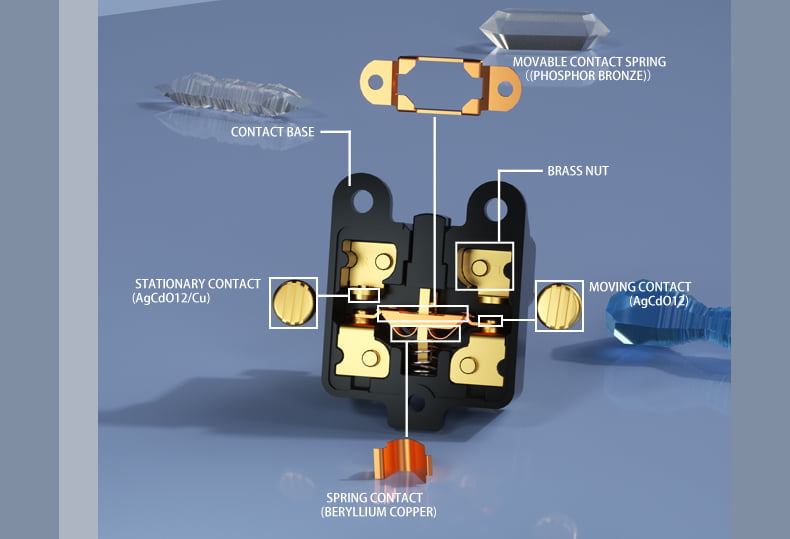
Deep within the heavy-duty housing resides the electrical contact block. It features fixed terminals and a movable contact bridge. The bridge is typically suspended by a highly elastic beryllium-copper or stainless-steel leaf spring, allowing the contacts to switch states safely in a matter of milliseconds.
2. Micro-Mechanics: How the Limit Switch Working Principle Functions
Understanding how an industrial limit switch triggers requires looking closely at the internal mechanical stroke. Every limit switch operation follows a highly predictable geometric timeline during machine contact.
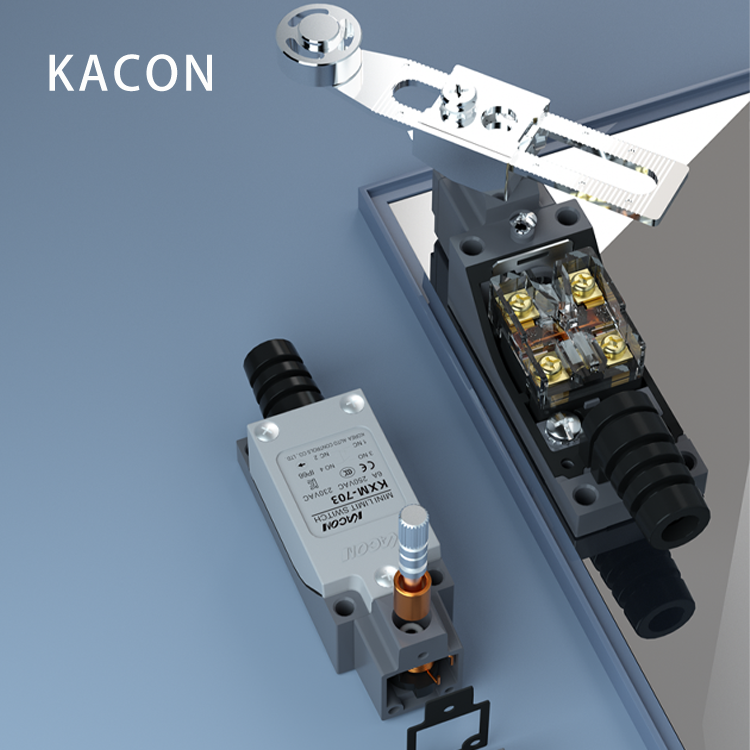
When an external cam forces the actuator head downward, the movement passes through four core physical thresholds that every automation engineer must factor into their layout designs:
- Pretravel (PT): The initial distance or angle the actuator must travel from its free position to reach the exact point where the internal electrical contacts trip.
- Operating Position (OP): The precise geometric point where the internal spring mechanism destabilizes and instantly snaps the contacts into their alternative electrical state.
- Overtravel (OT): The safety margin of travel allowed beyond the operating point. Generous overtravel buffers prevent the physical impact of heavy machinery from smashing the delicate internal microswitch components.
- Movement Differential (MD): Also widely known as Mechanical Hysteresis, this is the physical distance between the operating point and the release point. A precise, controlled differential prevents “signal chatter” or false triggering caused by industrial machine vibrations.
Snap-Action vs. Slow-Action Mechanisms
- Snap-Action Reliability: The internal contact bridge switches instantly, independent of how fast or slow the external actuator is pushed. This instantaneous transition drastically reduces electrical arcing, prevents contact pitting, and significantly extends the electrical lifespan of the switch.
- Slow-Action Precision: The contact movement is directly proportional to the travel speed of the actuator. While niche, it is occasionally used in ultra-slow, manual micro-adjustments where timing must mirror mechanical movement perfectly.
3. The Cornerstone of Safety: The Certified Positive Opening Mechanism
In safety-critical circuits—such as emergency stops, safety interlocking gates, or heavy crane travel limits—relying on standard electrical components can be incredibly dangerous.
Consider a failure scenario where an electrical overload or sudden current spike causes the contacts to micro-arc and weld together. In a standard switch, when the actuator is released, the internal return spring lacks the physical force to break that weld. The switch remains electrically closed, the machine keeps running, and a catastrophic accident occurs.
To eliminate this risk, international safety regulations require strict compliance with the IEC 60947-5-1 Standard, which mandates a certified Positive Opening Mechanism.
How it Works in Kacon KXL Series:
Inside a Kacon switch, a direct, non-resilient mechanical linkage connects the external actuator head directly to the NC (Normally Closed) contact carrier. When the actuator travels to its designated positive opening position, the mechanical force of the moving machinery is transmitted via a rigid internal slider to physically force the welded contacts apart. Even if the spring shatters or the contacts are heavily welded, the physical movement of the machine forces the circuit open, triggering an immediate safe shutdown.
4. Materials Science: Selecting the Right Contact Metallurgy
To ensure your limit switch operates reliably across millions of high-frequency automation cycles, the contact metallurgy must match your specific electrical load requirements:
- Silver Alloy Contacts: Purpose-designed for high-voltage, high-current environments (e.g., direct control of contactor coils or motor star-delta starters at $240\text{V}/10\text{A}$). Silver alloy handles the intense heat of electrical arcing without degrading.
- Gold-Plated Contacts: Essential for low-voltage, micro-current digital logic circuits. Silver contacts can develop a micro-thin layer of surface oxidation over time; while high voltage easily burns through this layer, micro-currents cannot, leading to intermittent signal failures. Gold does not oxidize, ensuring zero-fault data transmission to modern PLC digital control systems.
5. Frequently Asked Questions (FAQ) About Industrial Limit Switches
Q1: Why do mechanical limit switches remain superior to solid-state proximity sensors in safety circuits?
Unlike solid-state proximity sensors that can fail in a permanent short-circuit state due to voltage spikes or suffer from severe EMI (Electromagnetic Interference), mechanical limit switches offer true Galvanic Isolation. When open, there is zero physical pathway for electrical current to leak, guaranteeing an absolute safe state for emergency loops.
Q2: How does proper pretravel and overtravel management affect limit switch lifespan?
If a machine cam pushes a switch completely to its physical mechanical limit without utilizing the designated overtravel buffer, the housing experiences severe internal stresses, resulting in premature cracking or actuator snapping. Always design your cams to actuate the switch past the Operating Position (OP) but well within its maximum Overtravel (OT) limit.
6. Optimize Your Automation Reliability with Kacon
Choosing a premium limit switch means choosing engineered safety, predictable operation, and absolute factory uptime. Kacon’s KXL Series incorporates die-cast heavy housings, premium double-lip NBR seals, snap-action agility, and certified positive opening safety to match the highest global B2B standards.
Ready to upgrade your machinery or need a drop-in cross-reference guide for a legacy automation system?