
When designing or maintaining an industrial automation system, engineers often spend hours calculating electrical contact capacities or cross-referencing ratings. Yet, one of the most common culprits behind unexpected line stoppages is completely mechanical: selecting the wrong limit switch actuator.
The actuator is the “mechanical hand” of the switch. It physically interacts with moving machinery and translates kinetic energy into an electrical signal. Choose the wrong mechanism, and you face bent levers, sheared plungers, or premature microswitch failure.
In this comprehensive guide, we will break down the most common limit switch transmission mechanisms, analyze their mechanical behaviors, and give you a bulletproof blueprint for your next B2B application.
1. Limit Switch Actuator Selection Decision Tree: Quick Diagnostic
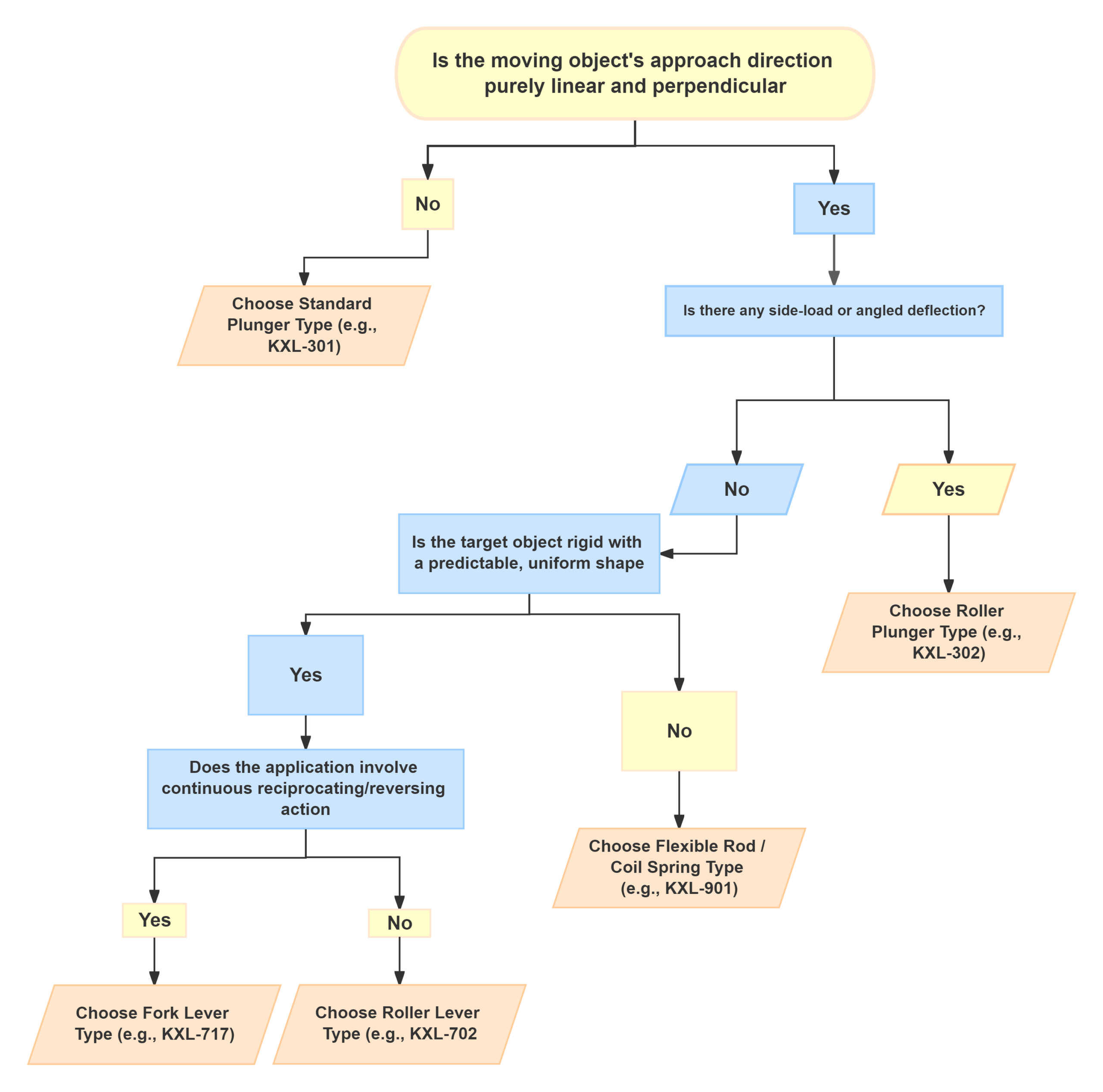
Before diving into the technical specifications, use our engineering flow logic to narrow down your mechanism type in under 60 seconds:
2. Deep Dive: Common Limit Switch Transmission Mechanisms & Technical Profiles
① Plunger Limit Switch Type: Precision for Linear Movements
The plunger type is the most fundamental mechanical transmission mechanism. It relies on a direct, straight-line impact to actuate the internal contacts.
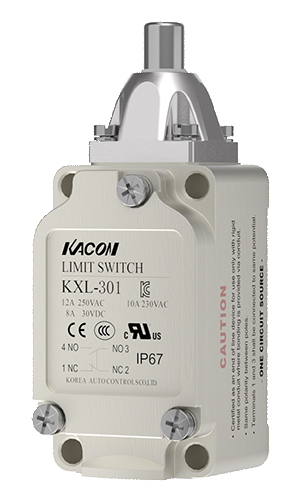
- Working Principle: Direct linear impact on the plunger triggers the internal microswitch.
- Strengths & Limitations: It minimizes Mechanical Hysteresis to offer highly repeatable positioning accuracy, but it features a short travel distance. It demands exceptionally high mounting precision and remains highly vulnerable to lateral or angled impacts.
- Target Environments: Ideal for machine table end travel limits and precise mold closure detection.
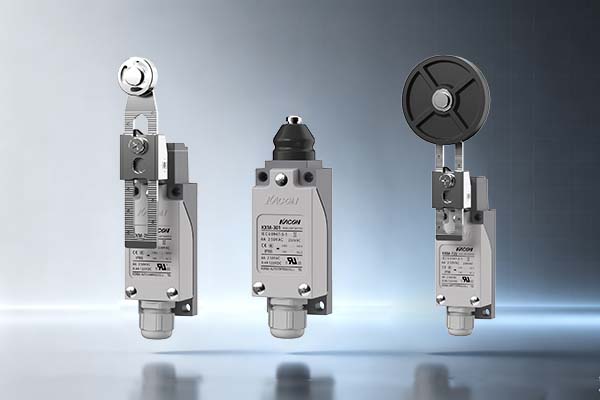
② Roller Lever Limit Switch Type: The Flexible All-Rounder
If you need versatility, the Roller Lever is the undisputed king of the factory floor. It converts rotational or angled movement into linear force to trigger the internal switch.
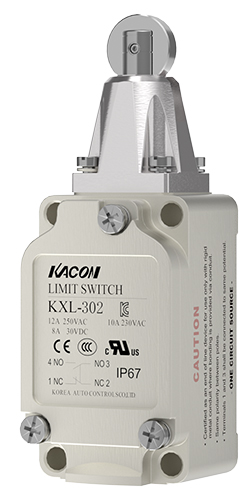
- Working Principle: An approaching object impacts the roller, which rotates the arm and drives the internal mechanism.
- Strengths & Limitations: Highly versatile. The lever length is typically adjustable, allowing users to vary the operating torque and travel distance by altering the arm length.
- Target Environments: Widely used in conveyor cargo inspection and crane travel motion control.
③ Flexible Rod / Spring / Whisker Limit Switch Type: Master of Irregular Shapes
When dealing with unpredictable or non-rigid items on a high-speed packaging line, a rigid lever will either crush the product or shatter under erratic impacts.
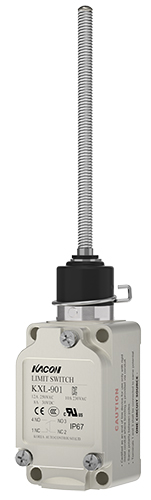
- Working Principle: By utilizing a spring steel wire or nylon rod capable of bending in any direction, the switch is designed to be triggered by any multi-directional force.
- Strengths & Limitations: It is the ideal choice for irregularly shaped objects. Because its exceptionally large Overtravel minimizes the risk of mechanical damage, it can take massive deflections without failing.
- Target Environments: Perfect for conveyor bag detection and car wash vehicle positioning systems.
④ Fork Lever Limit Switch Type: The Reciprocating Workhorse
Unlike traditional switches that spring back to their original position immediately, the Fork Lever type is a “maintained-contact” mechanism.
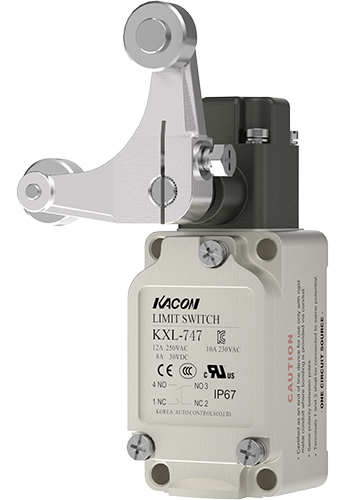
- Working Principle: It utilizes dual opposing levers. The forward stroke pushes Arm A (Trigger & Hold), while the return stroke pushes Arm B (Reset).
- Strengths & Limitations: No continuous mechanical contact is required to hold the signal state, making it perfectly suited for reciprocating automated control.
- Target Environments: Standard in rail-mounted crane reversing and heavy industrial travel limit control systems.
3. Industrial Cross-Reference: Kacon Limit Switches vs. Global Premium Brands
When maintaining legacy equipment or designing global-standard machinery, finding an exact mechanical and electrical equivalent is crucial to minimizing downtime.
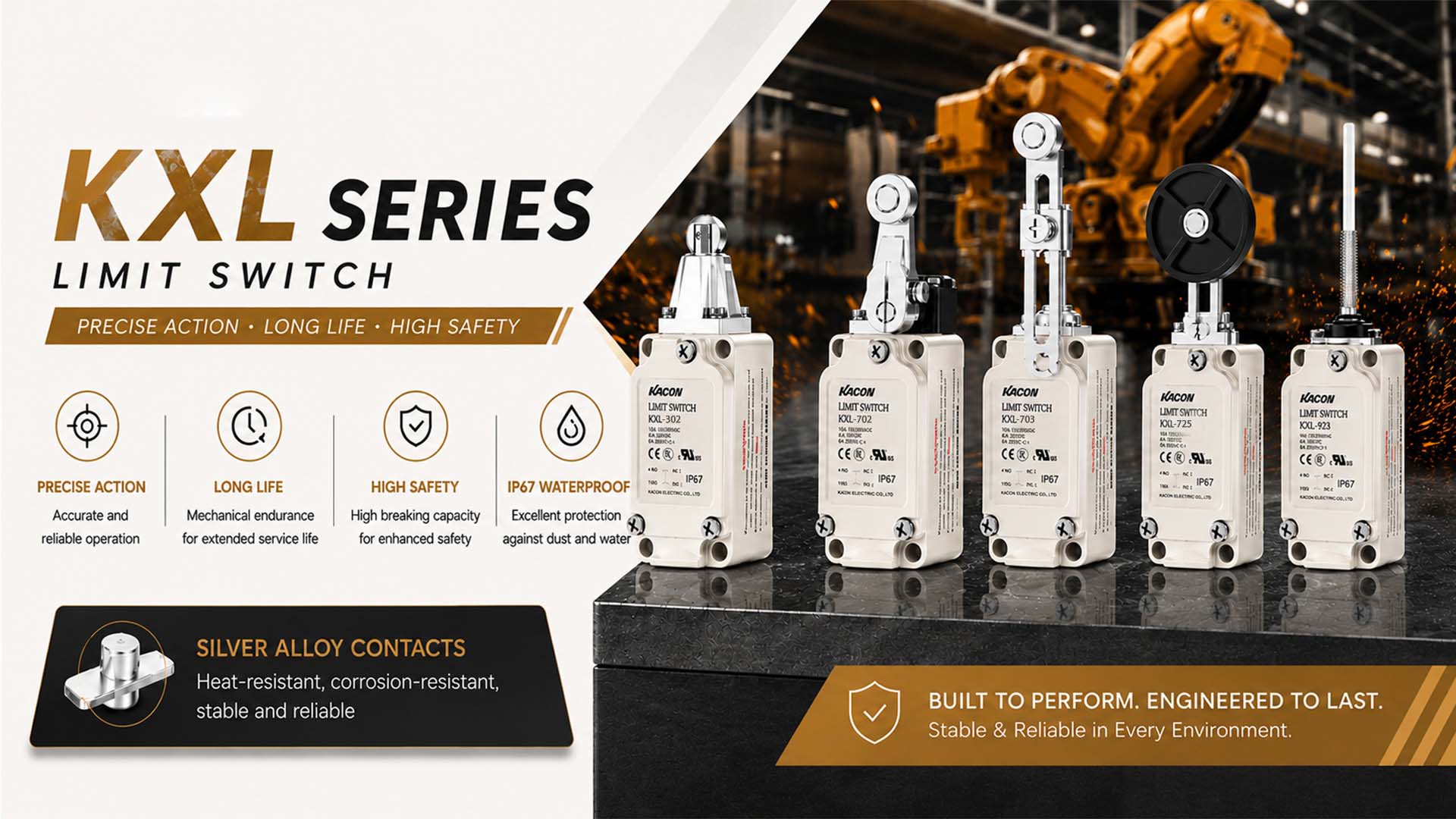
Below is a quick cross-reference guide comparing Kacon (KXL Series) heavy-duty limit switches with equivalent high-end models from global industry leaders, all engineered while maintaining a rugged IP67 Ingress Protection rating against cutting oils and coolant.
| Actuator Mechanism Type | KACON (Premium KXL Series) | OMRON (WL-N Series Equivalents) | SCHNEIDER (ZC Series Equivalents) | HONEYWELL (GL Series Equivalents) |
|---|---|---|---|---|
| Standard Plunger | KXL-301 | WLD18-N | ZC2JE61 | GLAA01B |
| Roller Plunger | KXL-302 | WLD2-N | ZC2JE62 | GLAA01C |
| Standard Roller Lever | KXL-702 | WLCA2-N | ZC2JY11 | GLAA01A1A |
| Adjustable Roller Lever | KXL-703 | WLCA12-N | ZC2JY31 | GLAA01A2A |
| Flexible Rod / Coil Spring | KXL-901 | WLNJ-N | ZC2JY51 | GLAA01E7B |
⚠ Engineering Note on Form-Factor Compatibility: These premium series are manufactured in strict accordance with the IEC 60947-5-1 Standard for control circuit devices. Kacon’s KXL series features standard industrial mounting hole patterns to serve as seamless drop-in upgrades.
4. Mechanical vs. Proximity Sensors: Why Limit Switches Still Rule
In an era dominated by photoelectric and inductive proximity sensors, mechanical limit switches remain irreplaceable for one reason: absolute safety and reliability.
Unlike proximity sensors that rely on solid-state semiconductor outputs, mechanical switches offer true Galvanic Isolation. Furthermore, a high-quality limit switch provides a true Positive Opening Mechanism to physically force the NC (Normally Closed) contacts apart in safety-critical circuits. Even in the event of a severe voltage spike or a welded contact micro-arcing incident, the mechanical force overrides the failure, ensuring the emergency stop loops execute perfectly.
Frequently Asked Questions (FAQ) About Industrial Limit Switches
Q1: What is the primary cause of plunger-type limit switch jamming?
Most plunger jams stem from off-axis side loads or particulate buildup inside the shaft housing. If your environment involves heavy dust or liquid spray, ensure your switch uses a premium NBR boot seal, or switch to a roller lever type which handles complex entry angles far better.
Q2: Can Kacon limit switches handle both AC and DC control circuits?
Yes. The KXL series is equipped with heavy-duty silver alloy contacts capable of switching standard industrial loads, making them highly versatile for PLC inputs or direct contactor coil switching.
5. Need a Kacon Limit Switch Drop-in Replacement or Bulk B2B Quote?
Don’t let a poorly matched actuator stall your automated production line. Our engineering department provides free application audits and direct cross-reference verification to ensure your machinery runs at maximum uptime.