
Common Limit Switch Problems: Diagnosis, Troubleshooting & Solutions Guide
In industrial automation, limit switches serve as the watchful sentinels of machinery. They verify physical positions, guard safety access doors, and prevent dangerous mechanical overtravel. Because they endure continuous mechanical impacts, high vibrations, and harsh environmental exposure, limit switches are among the most frequently stressed electrical components on any production line.
So, what are the most common limit switch problems?
Below, we examine this question through a real-world case study on diagnosing “ghost faults” on a transfer line, analyze the four most common physical and electrical switch failures, and provide a comprehensive troubleshooting matrix to maximize industrial uptime.
1. Real-World Client Case Study: Diagnosing Ghost Faults on a Transfer Line
A major automotive parts manufacturer in the Midwest recently integrated a series of automated welding transfer lines. During initial high-speed testing, the line would randomly halt with a “Safety Interlock Open” error code on the Human-Machine Interface (HMI), even though visual inspection confirmed every machine guard door was firmly closed.
The Troubleshooting Puzzle
The plant’s maintenance team spent hours checking terminal screw torque, measuring line continuity, and replacing entire cable harnesses. Mechanically, the limit switches clicked crisply when actuated. However, the Programmable Logic Controller (PLC) repeatedly dropped its 24V input signal.
Upon deeper diagnostic review by a senior control engineer, the root cause was uncovered: contact oxidation.
- Micro-Load Limitations: The plant was using generic limit switches with standard silver-alloy contacts. Because modern PLCs operate on low-voltage micro-loads (24V DC at currents under 10 mA), there was insufficient current to generate a cleaning micro-arc.
- Oxidation Barrier: Over weeks of operation, a microscopic layer of oxide formed on the closed silver contacts. Even though the switch was mechanically closed, the oxide layer acted as an insulator, blocking the 24V signal and triggering intermittent “ghost faults.”
The Kacon Solution
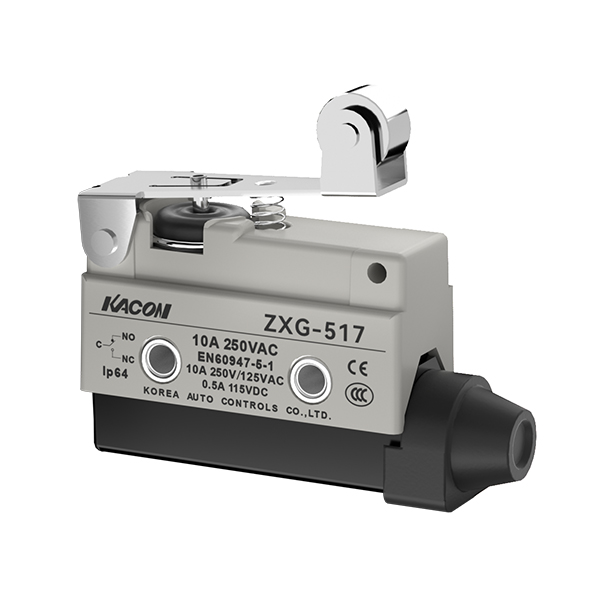
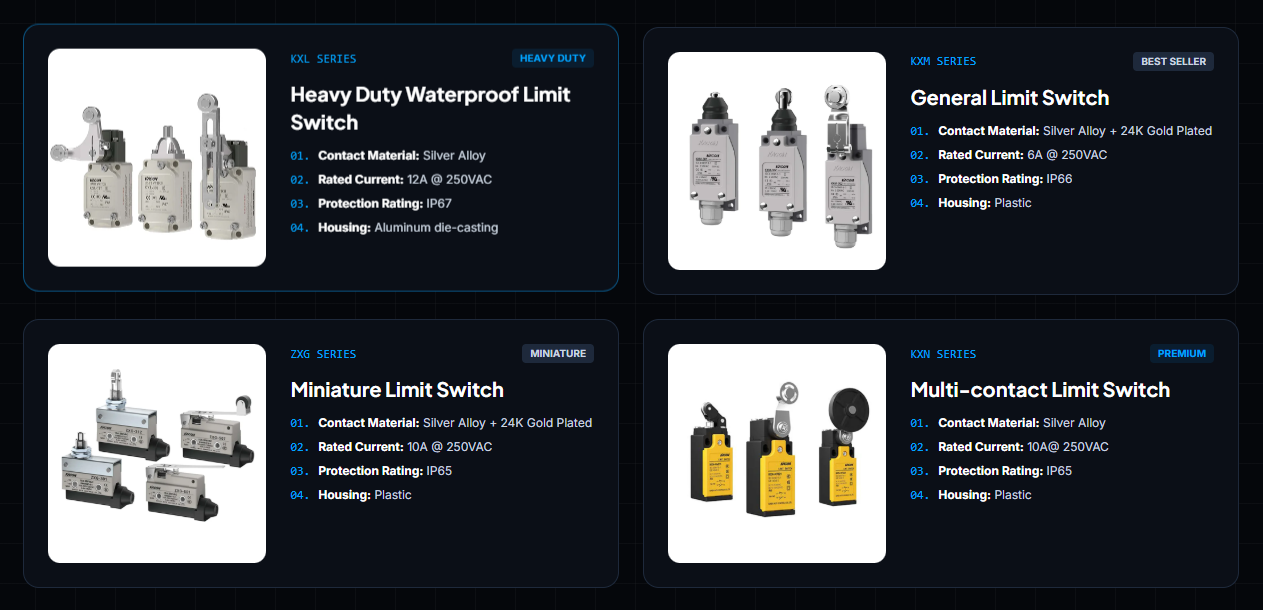
The facility retrofitted the problematic stations with Kacon ZXG and KXM series limit switches featuring Ag alloy / 24K Au Plate (gold-plated) contacts. Because gold is chemically inert and immune to oxidation, contact resistance remained low, ghost faults vanished instantly, and the transfer line resumed continuous operation.
2. The Four Most Common Limit Switch Failures
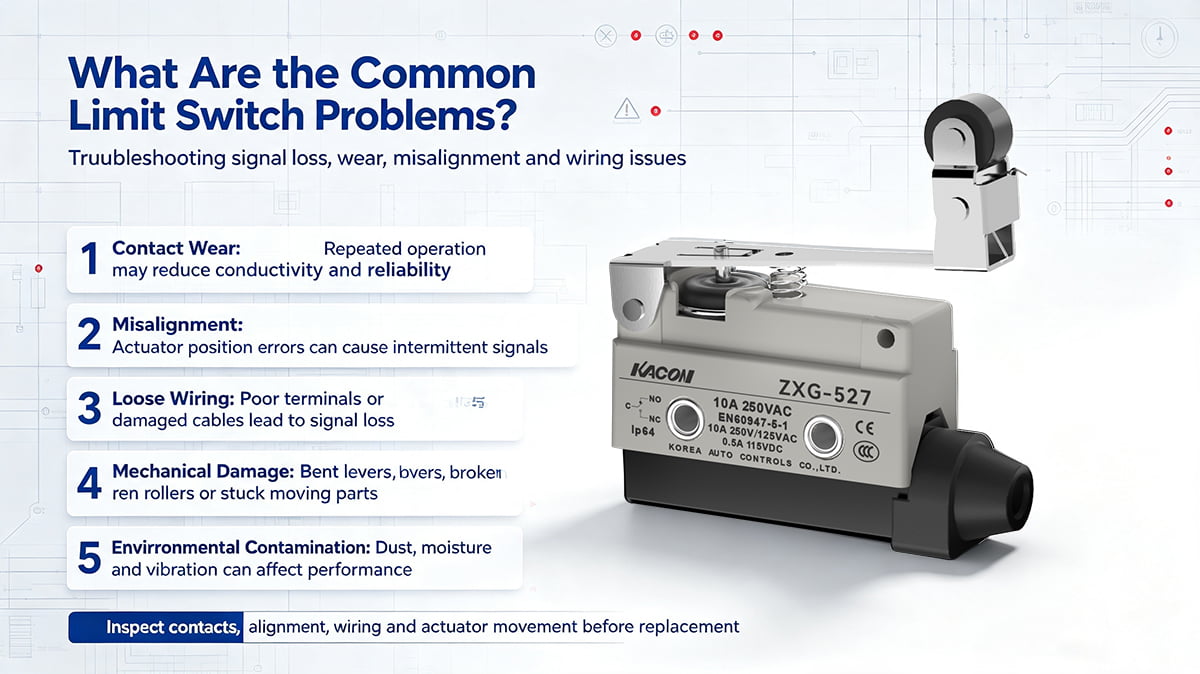
Whether caused by electrical anomalies or harsh physical operating conditions, limit switch failures generally fall into four primary categories:
1. Contact Oxidation (Micro-Load Signal Loss)
As illustrated in the case study, low-voltage PLC input loops (24V DC at under 10 mA) cannot generate the arcing needed to burn away surface film on standard silver contacts. Over time, oxidation builds up, turning a mechanically closed contact into a high-resistance barrier ($\ge 100\,\Omega$) that the controller reads as an open safety loop.
2. Mechanical Jamming & Debris Buildup
Limit switches rely on precision internal return springs and plunger guides. In machining, metal stamping, or woodworking environments, flying metal chips, dust, and dried coolant residue can pack into the actuator head. This physically jams the roller lever or plunger inward, preventing the internal springs from resetting and triggering constant overtravel alarms.
3. Environmental Ingress (Fluid & Oil Contamination)
When limit switches in high-pressure washdown zones or coolant spray areas lack proper ingress sealing, fluids bypass degraded rubber gaskets. Moisture and cutting oils cause internal short circuits, corrode terminal screws, and scramble digital input signals to the PLC card. Protection levels are governed by international standards such as IEC Ingress Protection (IP) Ratings and NEMA 250 Enclosure Specifications.
4. Actuator Misalignment & Physical Fatigue
Repeated physical impacts from fast-moving cams or machine slides can bend roller lever arms, loosen mounting hardware, or fatigue internal return springs. When a target misses the actuator or strikes it at an improper angle, the switch fails to trigger within required motion timing windows.
3. Troubleshooting Matrix: Common Limit Switch Problems & Solutions
Use this reference matrix on the factory floor to quickly diagnose limit switch symptoms and select appropriate corrective hardware:
| Common Problem | Root Cause | HMI / PLC Symptom | Recommended Solution / Hardware Upgrade |
|---|---|---|---|
| False “Open Loop” Signal | Contact oxidation in low-current 24V DC PLC loops. | “Safety Loop Open” / Intermittent E-Stop fault. | Upgrade to Kacon ZXG/KXM with 24K Gold-Plated Contacts. |
| Stuck Actuator / Mechanical Jamming | Metal debris, dust, or dried coolant buildup in actuator head. | Machine fails to reset; constant overtravel alarm. | Clean actuator assembly; specify sealed, gasketed plunger designs. |
| Fluid Ingress / Short Circuit | Coolant or washdown fluid bypassing low-grade seals. | Tripped breakers or erratic digital inputs. | Upgrade to Kacon KXL (IP67) or ELN (IP68) aluminum die-cast housings. |
| Physical Arm Fracture | High-impact target collisions or improper cam angles. | Switch fails to register physical contact. | Re-align target cam angle; upgrade to heavy-duty Kacon KXL series. |
4. Engineering for Reliability: How Kacon Solves Common Failures
Preventing limit switch issues requires matching hardware specifications to the physical and electrical operating environment:
- For Harsh, Wet Environments: Deploy heavy-duty aluminum die-cast housings like the Kacon KXL series, providing an IP67 rating against water, oil, and dust ingress, backed by a mechanical lifespan of 10,000,000 operations.
- For Low-Voltage PLC Loops: Specify 24K gold-plated contacts (available in the Kacon ZXG and KXM series) to maintain low contact resistance and eliminate micro-load oxidation. Electrical diagnostics and continuity checks should follow standard procedures such as those in Fluke’s Guide to Continuity Testing.
- For Functional Safety Conformance: Ensure switches comply with international safety standards, including ISO 13849-1 Machine Safety Guidelines and OSHA Machine Guarding Standards.
Conclusion: Preventing Unscheduled Downtime
Understanding common limit switch failure modes—from contact oxidation in micro-load circuits to fluid ingress and physical fatigue—is critical to maintaining high overall equipment effectiveness (OEE). By identifying root causes early and upgrading vulnerable positions to oxidation-resistant, properly sealed hardware like Kacon limit switches, engineering teams can ensure reliable, uninterrupted production.
External Technical References & Standards
For further technical documentation on limit switch selection, enclosure protection, and safety compliance, consult these industry resources:
- IEC 60947-5-1 Specifications for Low-Voltage Switchgear and Controlgear
- ISO 13849-1 Safety of Machinery – Safety-Related Parts of Control Systems
- OSHA General Industry Regulations for Machine Guarding
- NEMA 250 Standard for Electrical Equipment Enclosures
- Fluke Technical Guide: Testing Electrical Continuity with Digital Multimeters