
1. Limit Switch Single-Program Control and Safety Enforcement
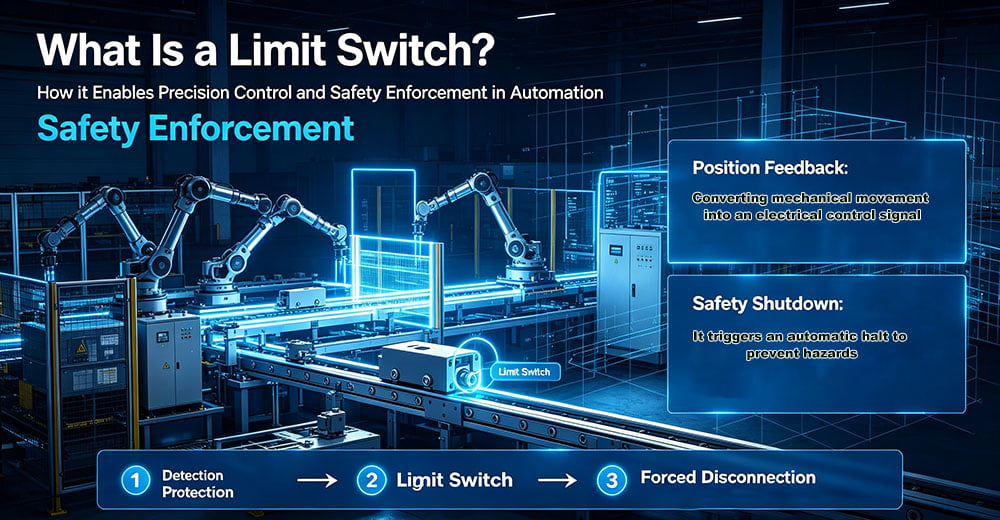
The first core function of a limit switch is governing a single, dedicated mechanical movement and acting as a physical guardrail for machine boundaries.
Precision Workpiece Positioning
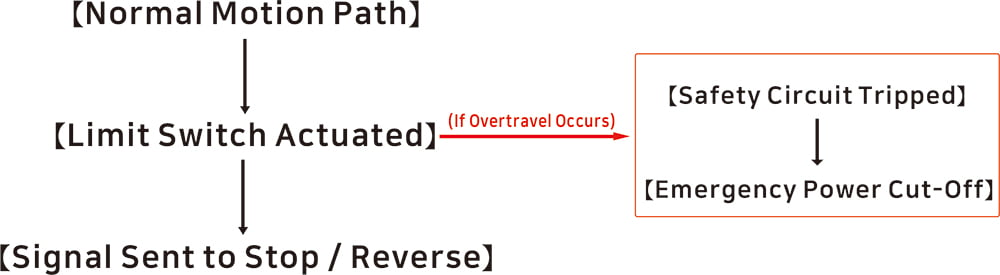
In automated machining and material handling, workpieces must remain strictly within designated working zones. A limit switch is installed at the precise boundary of the work area. As the slide table or workpiece carriage reaches its destination, it trips the switch’s lever or plunger, sending an immediate signal to the controller to halt travel or initiate the next stroke. This eliminates positional drift and ensures consistent machining accuracy across thousands of repeat cycles.
Safeguarding Personnel and Equipment
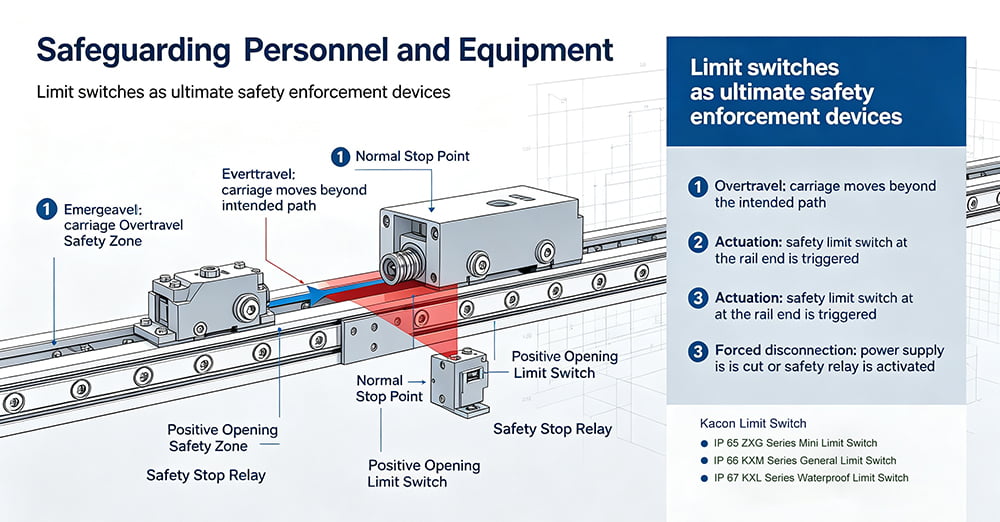
Equally important is the limit switch’s role as an ultimate safety enforcement device. Every moving axis has a defined “safe zone.” If a drive system malfunctions, a sensor fails, or an operator error occurs, the machinery may travel beyond its intended path.
When overtravel happens:
- The machine carriage physically strikes the safety limit switch installed at the extreme end of the axis guide rail.
- The switch instantly cuts power to the motor or triggers a safety stop relay.
- This immediate shutdown prevents heavy mechanical collisions, structural framing destruction, and catastrophic worker pinch-and-crush hazards.
For critical safety interlock applications, modern machinery standards—such as ISO 14119 for Machinery Guarding Interlocks—require these switches to feature forced disconnection (positive opening) to guarantee the circuit opens even if an electrical fault occurs.
2.Limit Switch Sequential Control in Automated Industrial Processes
While single-program control handles individual movements, complex modern factories rely on multi-stage manufacturing lines. Here, limit switches serve as the mechanical “clocks” that drive sequential automation.
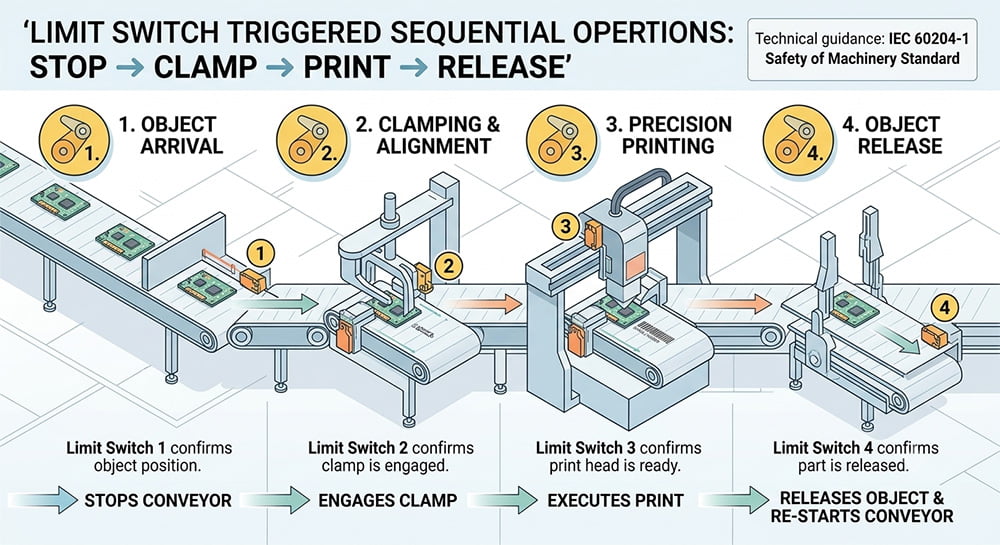
In a multi-step industrial workflow, process Step B cannot begin until process Step A is physically completed. Limit switches provide the foolproof physical feedback required to advance these sequences:
- Conveyor and Packaging Lines: As a box moves down a belt, it trips Limit Switch #1 to pause the conveyor. Limit Switch #2 detects that a pneumatic clamping cylinder has fully extended, triggering an automated inkjet printer to apply a label. Once printed, a third switch signals the clamp to release and the conveyor to restart.
- Machining Centers and Stamping Presses: In metal stamping, a safety limit switch confirms that the protective barrier is fully lowered before the press stroke can physically execute.
By providing deterministic physical signals rather than relying on estimated digital timers, limit switches prevent out-of-sequence collisions and ensure seamless coordination across complex automated cells. Technical guidelines regarding safety logic integration can be explored in the IEC 60204-1 Safety of Machinery Standard.
Single-Program Control vs. Sequential Process Control of Limit Switch
To help system integrators choose the right switch configuration for each role, the following matrix compares the requirements for both functional applications alongside Kacon’s specialized limit switch series:
| Feature / Requirement | Single-Program & Safety Enforcement | Multi-Step Sequential Process Control |
|---|---|---|
| Primary Operational Goal | Boundary stopping, overtravel prevention & operator safety | Workflow coordination, event triggering & cycle feedback |
| Typical Switch Mounting Location | Extreme ends of axis travel, safety doors, physical hard stops | Along intermediate conveyor paths, cylinder positions, indexing tables |
| Contact Priority | Normally Closed (NC) (Fail-safe loop) | Normally Open (NO) or NO+NC Combination |
| Key Performance Factor | High mechanical impact resistance & forced opening reliability | High repetitive precision, fast response & high electrical life |
| Recommended Kacon Series | Kacon Safety / Forced Disconnection Series (e.g., ZXG / KXM ) | Kacon Heavy-Duty Compact Series ( KXL) |
Why Engineers Choose Kacon Limit Switch for Precision & Safety Control
Whether you are designing a high-speed packaging sequence or enforcing critical machinery overtravel protection, switch failure is not an option. Kacon engineers industrial position switches to excel in both operational roles:
- For Sequential Precision: Kacon’s KXL Heavy-Duty Series features precision roller levers and plungers backed by a high-fatigue dual-spring snap-action mechanism. This guarantees crisp, rapid contact transition with high repeat accuracy over 10 to 15 million mechanical cycles.
- For Safety Enforcement: Kacon safety switches feature certified Positive Opening Operation (Forced Disconnection) housed in IP67-rated, oil-resistant zinc-alloy die-cast enclosures. Even in the event of severe electrical contact welding, the mechanical linkage forcibly shears the contacts open to shut down equipment safely.
- Vibration-Proof Terminal Architecture: Self-lifting captive terminal clamps prevent control wiring from shaking loose during high-vibration manufacturing cycles, reducing maintenance downtime.
Conclusion: Limit Switch is the Foundation of Reliable Automation
From enforcing simple axis boundary stops to orchestrating multi-stage robotic workflows, the humble limit switch remains a cornerstone of modern manufacturing. By understanding the distinction between single-program safety control and sequential process automation, plant engineers can select the right switch architecture—ensuring maximum uptime, high precision, and uncompromised workplace safety.
Explore Kacon Limit Switch Solutions