
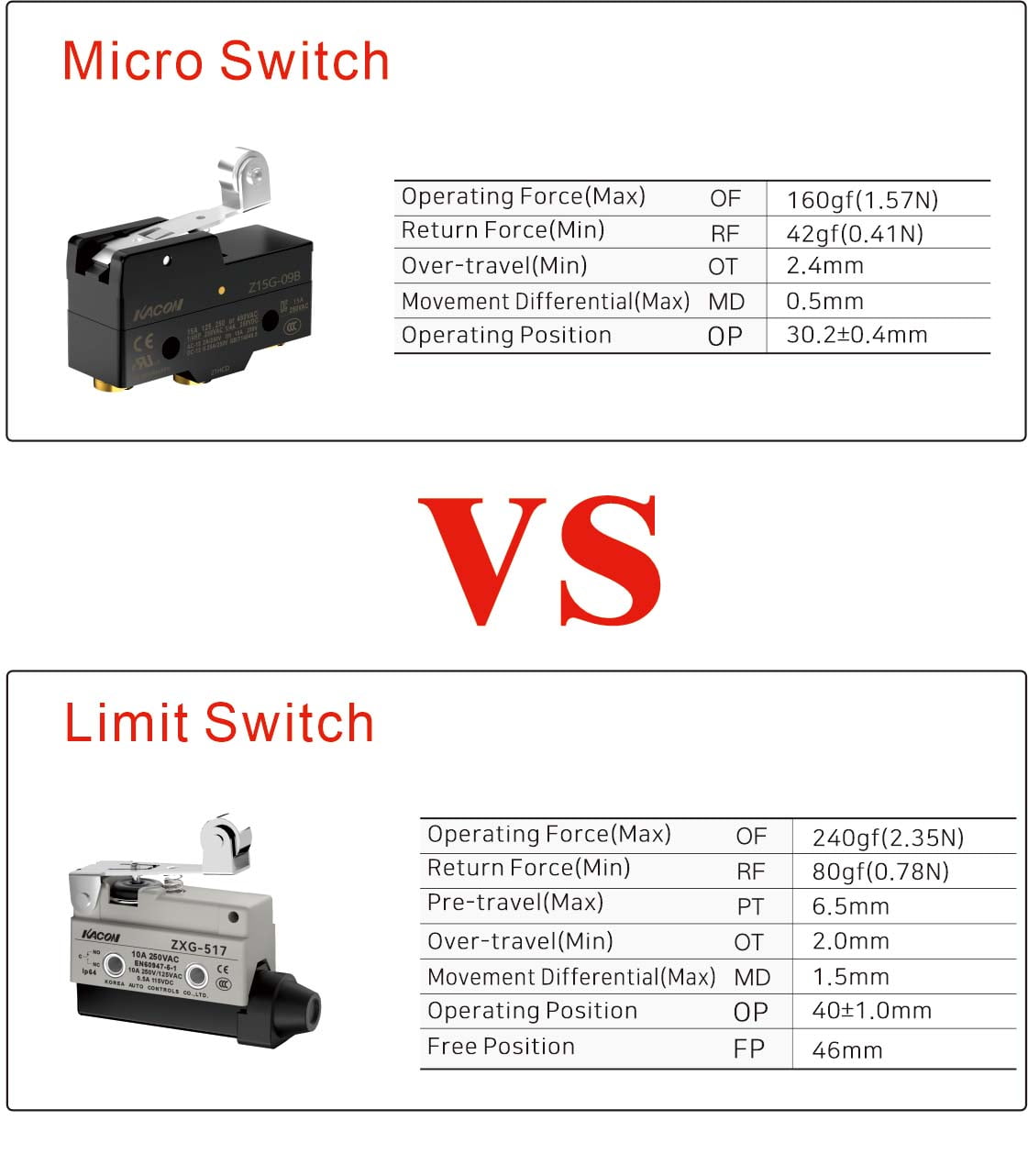
Below is a technical guide to the core industrial roles of micro switches, a real-world client deployment case study featuring Kacon hardware, and a practical comparison matrix.
1. What Is a Micro Switch Used For? Core Industrial Roles
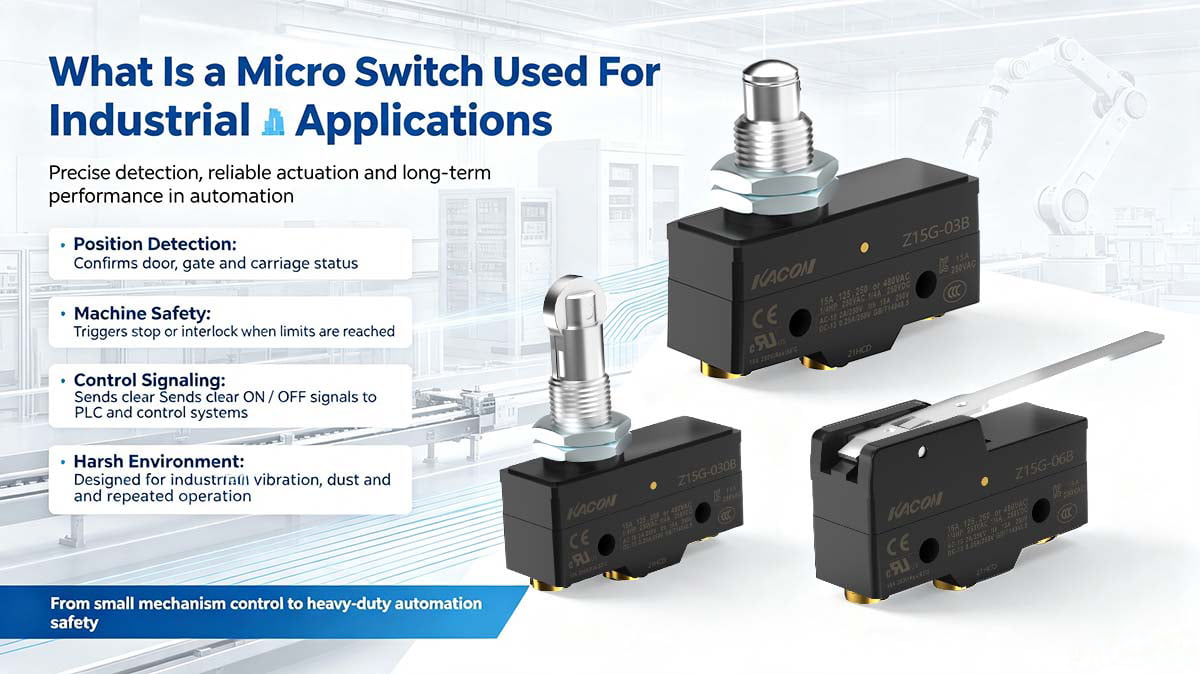
Because of its high actuation sensitivity, rapid snap-action contact speed, and dependable mechanical lifespan, the miniature switch is integrated into automated systems wherever precise physical movement or safety position feedback is required:
- Precision Sequence Triggering: In high-speed assembly equipment and automated sorting lines, micro switches detect the arrival of moving components, sending instantaneous signals to the Programmable Logic Controller (PLC) to trigger the next step in the sequence.
- Safety Interlocks & Machine Guarding: Micro switches act as essential safety interlocks on protective enclosure panels, safety gates, and maintenance hatches. They ensure that equipment covers are completely secured before high-voltage drives, lasers, or mechanical presses can energize, helping plants comply with functional safety regulations such as ISO 13849-1 Machine Safety Guidelines.
- Limit & Position Monitoring in Tight Spaces: In compact machinery where standard heavy-duty limit switches cannot fit, micro switches serve as tight-tolerance position monitors for linear actuators, robotic grippers, and small pneumatic cylinders.
For technical guidelines regarding miniature switching mechanisms and low-voltage control circuits, engineers regularly consult the IEEE Xplore Digital Library and standards defined in IEC 60947-5-1 Low-Voltage Switchgear Standards.
2. Real-World Client Case Study: Solving Low-Current Failures in Automated Packaging
The true value of selecting micro-control components engineered for low-power circuits is best demonstrated in real-world manufacturing environments.
The Client’s Challenge
A leading European manufacturer of high-speed pharmaceutical blister-packing machinery was experiencing intermittent, unexplained production stops. Their automated inspection station frequently triggered a “Sensor Signal Lost” error code on the main HMI, even though mechanical pick-and-place arms were physically depressing the target micro switches as designed.
Subsequent investigation by maintenance engineers revealed that the root cause was an electrical compatibility issue, not a mechanical failure:
- The packaging line’s PLC digital input channels operated on a modern low-voltage micro-load (24V DC at currents under 10 mA).
- The machinery had originally been fitted with general-purpose micro switches containing standard silver-alloy contacts.
- Because the 24V DC micro-load signal carried insufficient energy to generate a cleaning arc upon contact closure, a microscopic oxide film gradually built up on the silver contact surfaces.
- When the switch mechanically closed, this oxidation layer acted as an electrical insulator, blocking current flow. The PLC interpreted the high contact resistance as an open circuit (0V DC) and halted production.
The Kacon Solution
To permanently resolve the downtime, the equipment builder partnered with Kacon to retrofit their packaging machine line with precision control switches engineered specifically for dry-circuit PLC signals.
By replacing the standard units with micro switches equipped with Ag alloy / 24K Au Plate (gold-plated) contacts, the client eliminated contact oxidation. Because gold is chemically inert, it does not form tarnish or oxide films under ambient operating conditions, maintaining ultra-low contact resistance. Proper electrical continuity testing procedures for these low-voltage loops can be reviewed in Fluke’s Technical Guide to Continuity Testing.
The Result
Following the retrofit with Kacon gold-contact switches, the pharmaceutical packaging machines operated continuously through millions of production cycles without a single false signal loss error. The upgrade eliminated unscheduled downtime, proving that internal contact metallurgy is critical to signal integrity in modern 24V DC automation.
3. Micro Switch vs. Standard Limit Switch Comparison Matrix
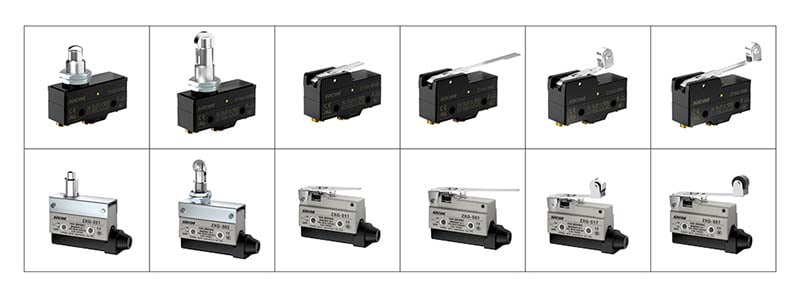
To assist design engineers in specifying the appropriate switching hardware for their specific machine footprint and environmental conditions, refer to the selection matrix below:
| Switch Type | Typical Physical Size | Actuation Force Required | Primary Industrial Use Case | Kacon Component Advantage |
|---|---|---|---|---|
| Micro Switch (Snap-Action) |
Ultra-compact / Miniature | Very Low (Light touch) |
Internal safety interlocks, high-speed assembly sequence triggering, compact PCB/jig sensing. | Rapid snap-action mechanism; optional 24K gold-plated contact blocks for micro-loads. |
| Standard Position / Limit Switch (e.g., Kacon KXM / ZXG) |
Standard industrial footprint | Moderate | General factory automation, sliding guard doors, conveyor position monitoring. | 1NO+1NC form factor; durable IP65/IP66 enclosures compliant with NEMA 250 Specifications. |
| Heavy-Duty Limit Switch (e.g., Kacon KXL Series) |
Large / Ruggedized | High | CNC machine axis overtravel protection, heavy industrial presses, outdoor washdown zones. | Die-cast aluminum housing; IP67 oil/water resistance; 10,000,000-operation mechanical life. |
Conclusion: Achieving Signal Reliability at Every Scale
What is a micro switch used for? At its core, it captures minute physical position changes and converts them into immediate, highly repeatable electrical signals.
As demonstrated in modern automated production lines, achieving high equipment uptime depends not only on external mechanical durability but also on internal electrical contact selection—such as the oxidation-resistant performance offered by Kacon’s 24K gold-plated contact architecture.
External Technical References & Standards
For further technical specifications on miniature switches, industrial enclosure ratings, and electrical signal testing standards, consult these authoritative industry resources:
- IEC 60947-5-1 Specifications for Low-Voltage Switchgear and Controlgear
- ISO 13849-1 Safety of Machinery – Safety-Related Parts of Control Systems
- NEMA 250 Specification Standard for Electrical Equipment Enclosures
- IEEE Xplore Digital Library – Electromechanical Control Research
- Fluke Technical Guide: Testing Electrical Continuity with Digital Multimeters