
1. Primary Synonyms: Position Switch & Travel Switch
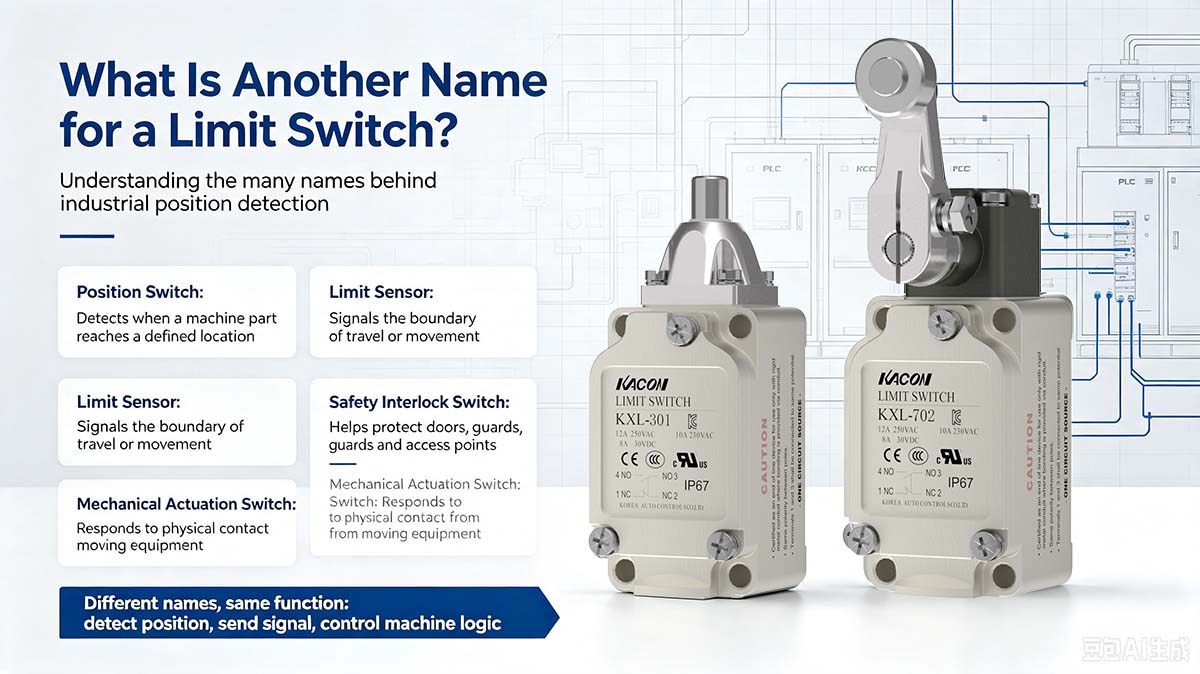
In international switchgear standards and global manufacturing catalogs, the terms position switch and travel switch are the most widely recognized alternatives to a limit switch.
- Position Switch: This is the most technically accurate synonym. Because the core function of the device is to detect the physical position of a moving machine component (such as a pneumatic cylinder, conveyor belt, or sliding guard door) and translate that motion into an electrical signal, major global manufacturers and standards organizations officially classify them under position switch product lines.
- Travel Switch: This term emphasizes mechanical motion along a defined axis. A travel switch is triggered precisely when a moving machine part reaches a designated distance or travel limit.
For official international definitions and standardized component classification, engineers rely on guidelines established by the IEC 60947-5-1 Low-Voltage Switchgear and Controlgear Specification.
2. Application-Based Functional Synonyms
In many automated plants, a limit switch is named after its specific functional job within a machinery safety or control circuit. Depending on its role, it may be referred to as:
Electromechanical Sensor
Because it bridges the physical world (mechanical impact) and the electrical world (discrete ON/OFF signals) through direct contact, it is broadly categorized as an electromechanical sensor within sensor taxonomy.
Safety Interlock Switch
When a limit switch is installed on a machine guard door, enclosure fence, or maintenance access panel to prevent human exposure to moving hazards, it is called a safety interlock switch or safety switch. These devices often feature specialized direct-opening mechanisms (positive opening contacts) compliant with functional safety standards like ISO 13849-1 Machine Safety Guidelines and workplace safety regulations under OSHA Machine Guarding Standards.
Overtravel Switch
In CNC machining centers, overhead cranes, and linear actuators, limit switches are placed at the maximum allowable physical limits of axis movement. In these high-stakes safety roles, they are called overtravel switches, end-of-travel limiters, or limit safety cut-outs.
3. Technical Distinction: Limit Switches vs. Proximity Switches
Although field technicians sometimes informally refer to proximity sensors as “electronic limit switches,” it is vital to distinguish between mechanical make-and-break devices and solid-state non-contact sensors:
| Feature / Metric | Electromechanical Limit Switch (Position Switch) |
Proximity Switch (Inductive / Capacitive) |
|---|---|---|
| Contact Type | Physical metallic contact bridge (Mechanical make-and-break) | Solid-state electronic transistors (NPN / PNP digital outputs) |
| Signal Characteristics | True “dry contact” discrete signal with zero off-state leakage | Solid-state switching (may exhibit minor off-state leakage current) |
| Environmental Immunity | High. Unaffected by dense dust, flying metal chips, or optical noise. | Can be sensitive to heavy accumulation of metal shavings or high EMI noise. |
| Enclosure Protection | Verifiable against NEMA 250 Specifications for Electrical Enclosures (IP67/IP68 die-cast bodies) | Standard threaded cylindrical or rectangular resin bodies |
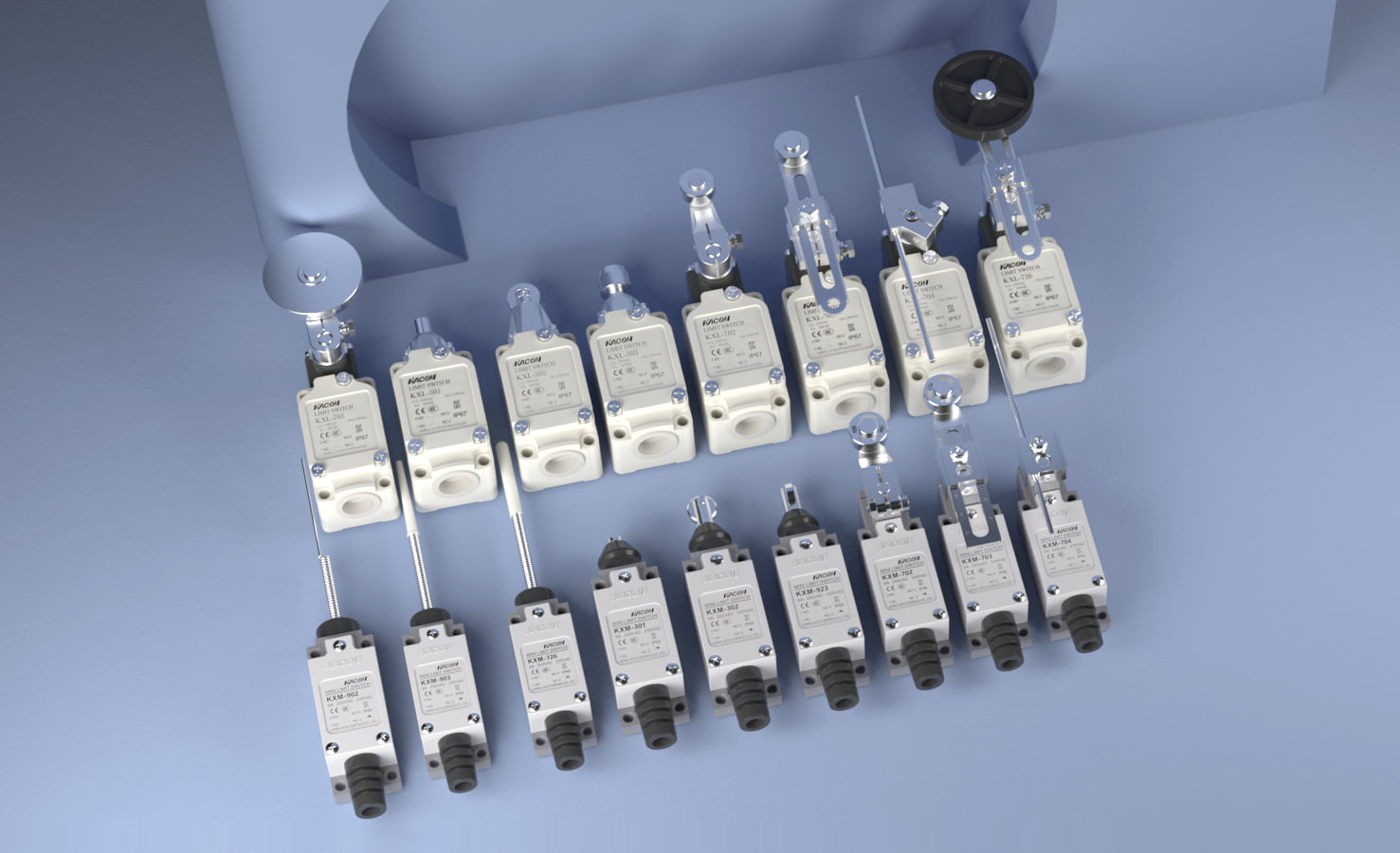
| Kacon Solution | Kacon KXL, ZXG, KXM Series (Heavy-duty aluminum housing, 24K gold-plated contacts) |
Standard electronic sensing lines |
4. Why Terminology Matters: Contact Reliability in 24V PLC Circuits
Regardless of whether hardware is called a limit switch, a position switch, or an overtravel interlock, its internal electrical reliability determines line uptime.
In modern automated control panels, position switches connect directly to Programmable Logic Controller (PLC) digital inputs operating on micro-loads (24V DC at currents under 10 mA). Standard silver alloy contacts in generic switches often fail in these low-power loops due to microscopic oxidation, which acts as an insulator and triggers false “Open Circuit” error codes. Diagnostic procedures for testing these micro-current circuits can be reviewed in Fluke’s Technical Guide to Continuity Testing.
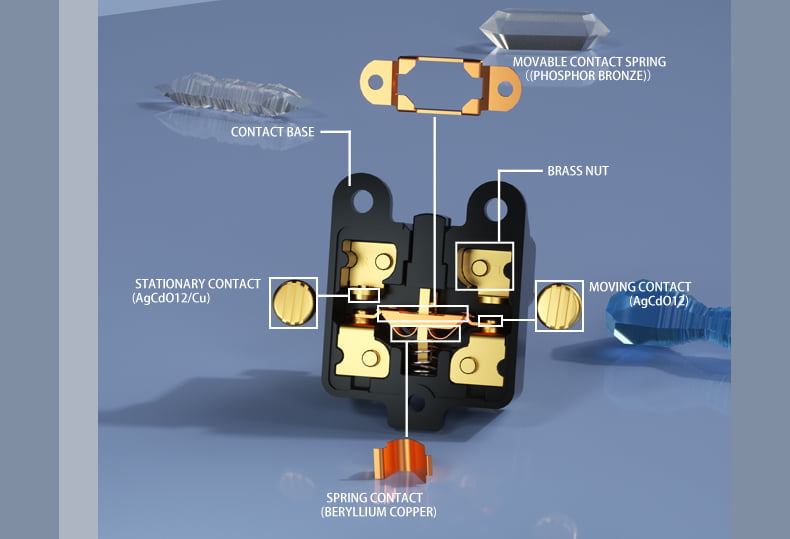
To ensure that your position switches deliver reliable signals regardless of terminology, premium manufacturers like Kacon construct their limit switch series with Ag alloy / 24K Au Plate (gold-plated) contacts. Because gold is chemically inert, it prevents oxidation entirely, ensuring that every actuation transmits a stable 24V DC signal directly to the PLC.
Conclusion: Master the Language of Industrial Automation
What is another name for a limit switch? Most commonly, it is a position switch or a travel switch, while terms such as safety interlock switch, overtravel switch, and electromechanical sensor are used depending on the specific application.
By understanding this nomenclature and specifying heavy-duty, gold-plated hardware—such as Kacon position switches—automation engineers can ensure that technical specifications match real-world performance, keeping automated production lines running safely and efficiently.
External Technical References & Standards
For further study on industrial switch nomenclature, enclosure protection, and electrical continuity testing standards, consult these authoritative industry resources:
- IEC 60947-5-1 Specifications for Low-Voltage Switchgear and Controlgear
- ISO 13849-1 Safety of Machinery – Safety-Related Parts of Control Systems
- OSHA General Industry Standards – Machine Guarding Regulations
- NEMA 250 Specification Standard for Electrical Equipment Enclosures
- Fluke Technical Guide: Testing Electrical Continuity with Digital Multimeters