

1. The Limit Switch Safety-First Principle: Why NC Contacts Take Priority
In safety-critical control architecture, the golden rule is simple: any system failure must result in a safe state (Fail-Safe Design). NC contacts inherently fulfill this rule through their “normally conducting, trip to break” operational model.
Immediate Response in Emergency & Limit Protection
In critical scenarios like emergency stop loops or axis limit protection:
- Under normal operating conditions, the NC contact remains closed, allowing control current to flow continuously through the safety loop.
- The moment a hazard occurs—such as a robotic arm overshooting a physical limit point—the actuator physically depresses the switch, opening the contact.
- This instantly cuts off power to the control coil or safety relay, halting dangerous mechanical motion without relying on complex digital processing delays.
Self-Monitoring Against Wire Disconnections
The major vulnerability of a Normally Open (NO) circuit is its inability to detect line faults. If a control wire snaps, loose terminals shake free, or power supply fails in an NO loop:
- The system remains silent. When an overtravel event finally occurs, the NO switch tries to close, but current cannot flow through the broken wire. The safety system fails blindly.
Conversely, an NC loop uses the presence of current to indicate a “safe” state. If a wire snaps or a connection comes loose, the current loop drops to zero amps immediately. The safety controller interprets this loss of signal as a physical trigger and shuts down the machine safely—exposing the electrical fault instantly before a collision can happen.
For deeper technical definitions regarding fail-safe circuit logic, engineers frequently reference the IEC 60204-1 Safety of Machinery Standards.
2. Limit Switch Electromechanical Reliability: The Power of Gold-Plated Contacts
While NC circuit logic provides the architectural safety net, the physical contact material dictates long-term switching reliability.
Modern PLCs and safety relays operate on low-voltage, low-current signals (typically 24 VDC at <10 mA). In these micro-load environments, standard silver-alloy contacts face severe operational limitations:
- The Silver Oxidation Barrier: Silver contacts rely on the electrical heat of high-current arcs (power switching) to burn away naturally forming oxide and sulfide films. In low-current PLC input circuits, arcing never occurs, allowing insulating oxide layers to build up over time.
- The Resulting Fault: The safety relay reads this high contact resistance as an open circuit, causing erratic machine shutdowns and false error codes.
Why Gold Plating Solves the Problem
To guarantee absolute signal integrity in low-power safety circuits, specifying limit switches with gold-plated contacts is essential:
- Zero Oxidation & Corrosion Resistance: Gold is a noble metal that does not oxidize or tarnish, even in hot, humid, or chemical-laden plant environments.
- Stable Low-Resistance Triggering: Gold contacts maintain extremely low and stable contact resistance across millions of low-current switching cycles, eliminating signal bounce and false PLC faults.
Guidelines regarding contact material selection under low-load conditions can be explored in the IEEE Electrical Contacts Technical Library.
3. Limit Switch Contact Selection Matrix: Matching Logic to Application
Although NC contacts with gold plating offer superior safety performance, proper component selection ultimately depends on your specific control logic and environmental demands.
The matrix below compares contact configurations across key performance metrics, highlighting specialized options from Kacon’s industrial switch series:
| Selection Factor | Normally Closed (NC) Contact | Normally Open (NO) Contact | Kacon Gold-Plated NC Series |
|---|---|---|---|
| Primary Design Intent | Safety Enforcement & Fail-Safe Protection | Sequence Triggering & Signal Sensing | High-Reliability Safety & Low-Current Sensing |
| Default Resting State | Closed / Conducting (Current flows) | Open / Non-conducting (No current) | Closed / Conducting (Gold-to-Gold interface) |
| Response to Broken Wires | Self-exposing (Causes immediate safe stop) | Undetectable (Remains open silently) | Self-exposing with zero false oxidation trips |
| Oxidation Resistance | Standard (Silver dependent on load) | Standard (Silver dependent on load) | Maximum (24K Gold plating prevents tarnish) |
| Ideal PLC Interface | 24V DC Safety Relays / E-Stop Loops | Standard Digital Inputs / Counting | 24V DC / <10mA Low-Power Safety PLC Inputs |
4. Limit Switch Balanced Application: When to Use NO vs. NC
To design a robust, cost-effective automation architecture, engineers balance both contact types based on operational roles:
When to Select NC Contacts (Priority 1):
- Emergency Stop (E-Stop) buttons and pull-cord switches.
- Mechanical overtravel limits at extreme ends of linear axes.
- Safety door interlocks and light curtain guard loops.
- Any safety-critical feedback loop connected to a safety PLC.
When to Select NO Contacts:
- Part presence detection along conveyor lines (counting workpieces).
- Routine cycle-start triggers (e.g., a cylinder fully retracting to start the next stroke).
- Non-critical operator indicator lights or annunciator horns.
Engineering Superior Safety with Kacon
Whether your design demands single-program overtravel enforcement or complex sequential process control, Kacon manufactures position switches engineered for uncompromised reliability:
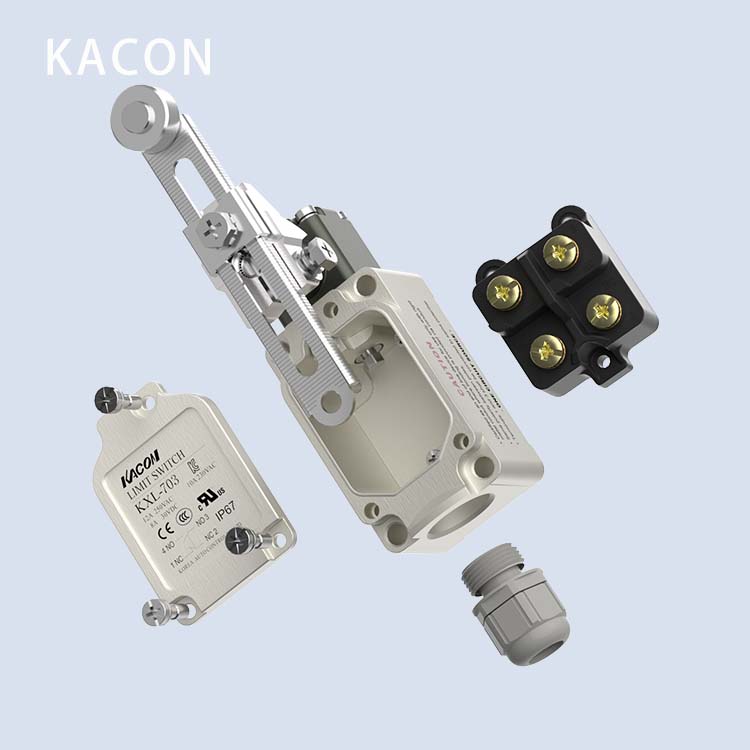
- 24K Gold-Plated Double-Break Contacts: Kacon’s safety limit switches and microswitches feature precision gold-plated contact points engineered specifically for low-voltage, low-current PLC inputs, ensuring stable conductivity over millions of operations.
- Positive Opening Mechanisms: In accordance with ISO 14119 interlock standards, Kacon safety switches incorporate rigid mechanical linkages that forcibly shear-open welded contacts during emergency actuation.
- Heavy-Duty Protective Housings: Sealed to IP67 ingress protection standards inside rugged zinc-aluminum die-cast or flame-retardant enclosures, Kacon switches resist coolant spray, cutting dust, and high mechanical vibration.
Conclusion: Elevating Safety Through Logic and Material Design
Prioritizing Normally Closed (NC) contacts in your control architecture aligns your machinery with modern fail-safe engineering principles. By pairing NC circuit logic with Kacon’s gold-plated switch technology, control designers effectively eliminate wire-break blind spots and contact oxidation issues—ensuring uncompromised operator safety and maximum plant performance.